
Disclaimer
I received a copy of the Hellborn book in exchange for this review. I did not play the game with others, but I did make a character and go through some imaginary scenarios to see how the game would play at the table to give it something of a fair shake.
After a short, post-review conversation with one of the game’s creators, I’ve learned English may be a second language, which may explain some of the issues I encountered involving confusion in some of the rules.
Take my opinions with all this in-mind.
What Kind of Game Is It?
Hellborn has a 2d6+Stat, meet-or-beat a difficulty rating (DR) system with classless character design and world that’s meant to evoke ideas of a futuristic, cyberpunk hell. And I mean that literally; hell in the Christian sense, filled with cyber-demons lounging near lakes of fire and impish hackers remotely gaining access to some demonic duke’s bank account. Samurai-sword-wielding succubi and fallen angel bodyguards whose services are sold to the highest bidder.
You play as a denizen of hell who makes their living as a mercenary of some sort. You are hired to do jobs, complete those jobs, and return to enjoy your spoils. Pretty straightforward.
Character Sheet
A character sheet should give one a half-decent idea of how well the fantasy of the game is going to stand up in play, because what’s on the sheet is what the user is meant to regularly interact with mechanically. If a game is all fluff, there’s little in the way of mechanics on the sheet to support the fantasy of the world. Some portions of the character sheet is given in pictures below.
The character sheet – and by extension, the game – is keen on combat. This makes sense, given the conceit is a group of demons working as a mercenary group. A character has Attributes of: Agility (Nimbleness and Stealth), Corpus (Physical Prowess), Soul (Force of Personality), Mind (Intelligence), and Essence, with four associated skills listed beneath each attribute, except for Essence, which is special and used when activating “Boons.”

There are some things that jump out at me as I go through this character sheet:
- Tarot – Provides you a bonus to some skill and gives you a unique way to gain experience.
- Species – A species of demon or sinner.
- Darkness Points – Mana points for using Boons.
- Death Threshold – How hardy you are against dying. Higher thresholds make you able to withstand the pull of death for longer, which is pretty neat. Something other systems could adopt.
- Boons – The best analog for Boons are the various schools of magic one would find in classic fantasy games, with spells of the setting being referred to as “Techniques.”
- Paths – The specific “skill trees” your character is focused in.
There are some things I find odd about the character sheet, however, like stats that probably don’t need to be there and things that should be, but are missing. For instance: Gender, Height, and Weight; are these necessary? In mechanics, are they really adding to the game or the characters? Does the player need to be reminded of them whenever they sit down to play the game? Will they forget that “Azura” their “Fallen Angel” is heavy set or tall? Is it important for play?
One of the other things I wish the sheet had was the ability to track training skills. In Hellborn, when you train to increase a skill during downtime, you can make a roll that – if successful – allows you to mark an “improvement point” on that skill. After doing this four times, the skill has its value increased by one. You can always increase a skill immediately via spending experience points, but I’m wondering why this improvement point marking was missed by the game developers.
The same is true for attributes; four improvement points and the attribute increases by 1, but again, there’s no built-in way to mark it on the sheet. That’s definitely something that’s easy to forget from session-to-session.

The choice of Primary and Secondary paths are important as these will make the experience costs lower than if they were your tertiary or quarternary paths. Paths are also the primary way you “build” your character in the same way that in a class system like Pathfinder, you have a set of abilities and traits that grow as you level.

Boons are like spells and add mechanical nuance to the character. They provide special capabilities that a base character otherwise couldn’t get, and much like paths, you tend to select a handful that you buy into, getting more powerful boons over time.

One thing of interest on the character sheet was this spread of character motivations and descriptions to flesh them out. I’m torn on how useful all of it is at the table, but it clearly expresses an interest in your investment as a player into the character and the world in which you find yourself. It should help ground characters in what is certainly an alien landscape – the burning hells. Having something like this to return to can be a helpful aid for many.
Essence and Spells (Boons)
Essence is an important attribute to call out, as it’s an odd duck when sitting next to the others, providing the character’s affinity for Hellborn’s version of spells, ability to recover darkness (Hellborn’s equivalent to mana), and the difficulty of casting. Having a greater bonus to Essence increases the difficulty of avoiding any Boon Technique you use against another. The roll to avoid a Technique is 6 + Essence Score of the wielder + the Technique’s level.
And while this feels good as a player, I wonder how it feels when an ability is turned against you. The difficulty rating seems high, since in my case, if the tables are turned against myself, I’d be rolling 2d6 + 3 (Agility) against a difficulty rating of 6 + 4 + 2 = 12 to avoid a Fireball, a 2nd Level Technique of the Ignis Boon. Even with a +3 in Agility, I can only avoid my own Fireball with a success probability of ~27.78%. And yes, it’s Rules-as-Written that some of your opponents will have “Any Level X Technique.”
Despite using the earlier analog of Boons as schools of magic, Boons aren’t magic per se (though you can interpret them that way); they are more spheres of control a given character has power over. Each technique within a given Boon is easily understood as a “spell,” but in Hellborn, they are the specific uses of your character’s power while they tap into their dark gifts.
There are a lot of interesting Boons and their Techniques. To list a few, there is “Adfectus,” which is concerned with manipulating the emotions of a target from causing them great sorrow to filling them with all-consuming passion. There’s “Divinus,” a remnant of the powers the fallen angels possess (and one of my favorites) with alternating boons/banes down the list of Techniques, such as “Raphael’s Touch,” providing either a bonus to a target’s Armor Rating for a round or healing them for a few hit points.
In order to use a Technique, the character must spend a number of Darkness points equal to the Technique’s level. So the more powerful techniques will drain your ability to use others rapidly. Given the usefulness of even level 1 Techniques and the amount of darkness an average character would have at creation, you can be extremely powerful and/or hardy right out of the gate with Boons, which is a good thing. They really do help you feel like you’re playing a demon.
Paths and Defining a Character
The best representation of what your character wants to do and how they intend to interact with the game is given through the Paths, and you get to build your own, piecemeal across two or more Paths. You select a Primary and Secondary path at character creation, which provide your character more innate abilities than what the attrition-based Boons provide.
There are paths like “Assassin” that give you bonuses to sneaking, access to sneak attacks, and stealthy ambushes. “Face” allows you to wheel-and-deal with the best, read others, and convince those around you that you’re not a threat. “Guardian” if you want to play something tanky, “Gunslinger” for neat marksman tricks with a gun, “Malefic” if you want to focus on dark powers, “Pugilist” if you want to speak with your fists, and so forth.
There are 10 paths in all, with abilities from Levels 1 to 5, and provde a fair amount of customization for any character idea you might have in-mind. When paired with Boons, you get some unique characters, at least in terms of their specialties.
Demon / Cyberpunk Balance
Hellborn seems heavily focused on the demons and the world of hell; the cybernetics would feel tacked on, except there are mechanics built around it.
First, as you install more cybernetic hardware on yourself, you can end up lowering your Essence, which can make it impossible to use many Boons. Each piece of cyberware has its own rating by which it will lower your Essence, so you can get away with getting just some cybernetic equipment without compromising your Essence at all.
Second, Cybernetic equipment is the only way to increase your attributes above the limit of 6. So if you want to increase your attributes to super-demon levels you’ll have to equip more cybernetics. (There are ways to get such increases through more supernatural means such as Boons, but they are typically temporary bonuses, while cybernetics are more permanent.)
There aren’t many interesting mechanics in Hellborn, but this is one of the notable few. It’s a mechanic that specifically forces you to choose between ancient ideas of hell and modern cybernetics. That’s kind of what Hellborn wants to be all-over, in my opinion, but it really only mechanically achieves it here. It’s a kind of guiding principle whose philosophy I wish was explored more concretely everywhere in the game system.
Difficulty Ratings
I don’t like the difficulty ratings at all. They seem to be too high for normal rolls in most situations, going even above that which I’ve seen in other games with similar mechanics, like Traveller, which has a default difficulty of all rolls on its 2d6+Stat system as an 8.

Some basic statistics information is important in mentioning this. With 2d6, your average result is 7, which makes Traveller’s usual Difficulty Rating target of 8 more palatable. Hellborn’s normal Difficulty Rating is 10! Now, this isn’t so bad when you’re rolling with an attribute as a stat, since they all start at 1, and at character creation, you’ll pump a fair few of them (and can do so for all of them) up to 3, which would put your 2d6+Attribute rolls at the normal DR of 10 on average.
But with a skill? No. You have fewer skill points at creation (only 10 to spend across all 16 skills), making it much harder to ensure you’ll succeed even “normal” rolls on average if you don’t specialize.
Another problem I have is that I never know when I should be using a skill vs. an attribute unless it’s specifically called out in the rules. The rules specifically say that when you fight with a melee weapon, you use “Fight” or “Force” (whichever is higher). But jumping a gap? Probably the Corpus Attribute, but there’s a lot of interpretation there. Maybe you should roll Force, since the skill includes pushing and pulling and might reasonably include other, similar feats of strength?
The implied rule seems to be that you use an Attribute unless there’s a skill that would fit for your roll. In which case, the game will run like a more unfair version of Traveller, since your base chance of success in Traveller is ~41.67% (with a Normal DR of 8 and +0 to a skill) and the base chance of success in Hellborn is ~16.67% (with a Normal DR of 10 and +0 to a skill).
Now, from the difficulty rating table provided, Hellborn implies characters might be capable of actions with DRs of 16 or more. This suggests that a character’s stats will eventually be the deciding factor of capability and competency rather than the dice themselves. I’m not exactly sure at what point in the game extremely competent characters are regularly capable of hard or very hard actions, but it seems a long way off to me, or at least, I have to spend a lot of XP just to have a better average success for things that are in the “normal” difficulty range.
Combat Can Have Far Easier Difficulty Ratings
Something of a quirk or perhaps by design in Hellborn is the difference between the difficulty inside and outside of combat. Outside, you have all these high “normal” Difficulty Ratings to hit (again, at 10 for “normal”), while inside combat, the ratings can seem more reasonable, because you can buy things that just remove bonuses your enemies will have attempted to stack.
With a few exceptions, the bonuses equipment provides are bent towards combat, which means you can get armor-piercing rounds and remove a target’s Armor Rating from, say 11 to 7 or 8. Now every attack – even with a +0 to your shoot skill – is going to hit on average. I’m not sure how easy it is to acquire armor-piercing rounds, but I would think them fairly easy to source or create in a world filled with demons.
But this is just looking at shooting your opponents. If you’re using your fists or you can’t reduce the Armor Rating of your opponents, it gets hard to hit them. If your opponents are using boons to attack you (like maybe with a fireball), your chances of avoiding some attacks is incredibly low.
The game seems to encourage you to murder your way through problems, and the odds appear really stacked against you otherwise.
Lots of Confusion
The book needs another pass or two from an editor, since I had SO MANY questions while trying to figure out how to run through scenarios with my hastily-constructed character.
The first issue was character creation. There wasn’t a short-hand visual description for several of the species available to play, which makes it necessary to go back to the background of the setting for each ring of hell in order to find the species of interest there. To be clear, there’s only one or two per ring, so you have to go back through several to find the species you’re looking for. The appearance information for them can be fleeting as well, which is frustrating.
I had to keep going back and forth between the initial character creation guidelines and the specific sections relating to pacts and boons, because there was no quickstart guide that specifically tells a reader how many boons or pacts they get at character creation unless you go to said sections. And that information – when you are in the right section – is harder to find than I would have liked.
I’ve already covered the implied rules about when to use skills vs. attributes.
Then there were the confusions on particular wordings of the pacts.
Take “Retaliation” (from the Guardian Path; a level 3 power) which maybe I’m just completely misreading, but it confuses me.
RETALIATION
Hellborn, Pg. 125
Time to pay.
Whenever an allied creature within 5 meters of you is attacked by another creature, you can immediately make an attack against the attacker as long as they are within range of any of your weapons. You can use this perk once per Downtime Phase.
So how is Retaliation supposed to work? Is it whenever or is it once per Downtime Phase? Is it whenever for the duration of any one combat per Downtime Phase? I’m just not sure. Other subtleties in wordings across Paths popped up, and they varied from nitpicks to something overt like the “Retaliation” example here.
Confusions in Combat
Combat divides things up between “Actions” and “Extra Actions.” Maybe I’m too literal, but this confused the heck out of me. Semantically, if you have events that take place as an “Action” and other events that happen as an “Extra Action.” it suggests that the same Action can happen an Extra time.
But this may not be so. Hellborn’s combat section doesn’t always state what an Action is nor how it differs from an Extra Action, leaving things vague. Here is a snippet from the combat section specifically examining Actions, Extra Actions, and some examples of things a character can do in a combat turn.


From this, we see that an Attack is an Action, not an Extra Action. Interact is probably an Action, but the latter half of its explanation suggests it might be an Extra Action sometimes. You can Move for free once in a turn, and doing so again is an Action; no idea if you can move a third time in a round as an Extra Action. Boons are on a case-by-case basis.
The second image – a direct continuation from the text where it ends after “Use a Boon Technique” – suggests all interactions with items and the environment take an Extra Action, but then why is it not included under the “Interact” heading? I suspect there was actually another heading here that was forgotten: a “Use an Item” heading in red text, but it’s missing. You just have this trailing paragraph that technically is under the “Use a Boon Technique” heading, but because it comes at the top of the next column, it appears as its own, unlabeled heading.
Regardless, the question remains: Can I repeat any Action and treat it as an Extra Action? Can I make two attacks on my turn; once as an Action and again as the Extra Action? (The wording on the “Dual-Wielder” ability in the Assassin path seems to suggest you can’t, but I can’t find the normal rules for dual-wielding anywhere.)
If I could request just one thing from the authors, it would be to rename this “Extra Action” into something more easily understood. 3rd Edition D&D settled on Swift Actions, and we have Bonus Actions today in 5th Edition. Maybe borrowing some language from the established games wouldn’t go amiss here.
Somewhat Reminiscent of World of Darkness
…and not just for the poor editing, which White Wolf suffered from, but there’s a mechanic devoted specifically to downtime (which might have been more of a LARP/Cam thing than White Wolf per se), the playable species are referenced within the same breath as the game-world, and the Paths are spread across various branches of focus much like Vampiric Disciplines and Werewolf Gifts. The Boons (spells) and their schools are similar to Theban Sorcery magic paths, and if you take multiple Paths, those tertiary and quarternary paths have increased experience point costs. That “leveling-up” is done via XP expenditure is also a hallmark of the White Wolf line.
Luckily Hellborn isn’t as pretentious as the 90’s White Wolf games. It doesn’t want players to imagine languishing on their inner horrors of death as Vampire might; it wants you to jack-in to the net, sling hellfire, and get paid.
Visual Design
The layout and eye-catching quality of the book is exceptional. Hellborn provides the feeling of hell with dark reds, blacks, greys, and whites to paint the canvas of the game. It feels like a high-quality product put out by a big studio.
Just look at this section of a page and how it’s laid out in the following picture. Nice top-page headers, colored text blocks of useful side information, and a unique look for its headings.
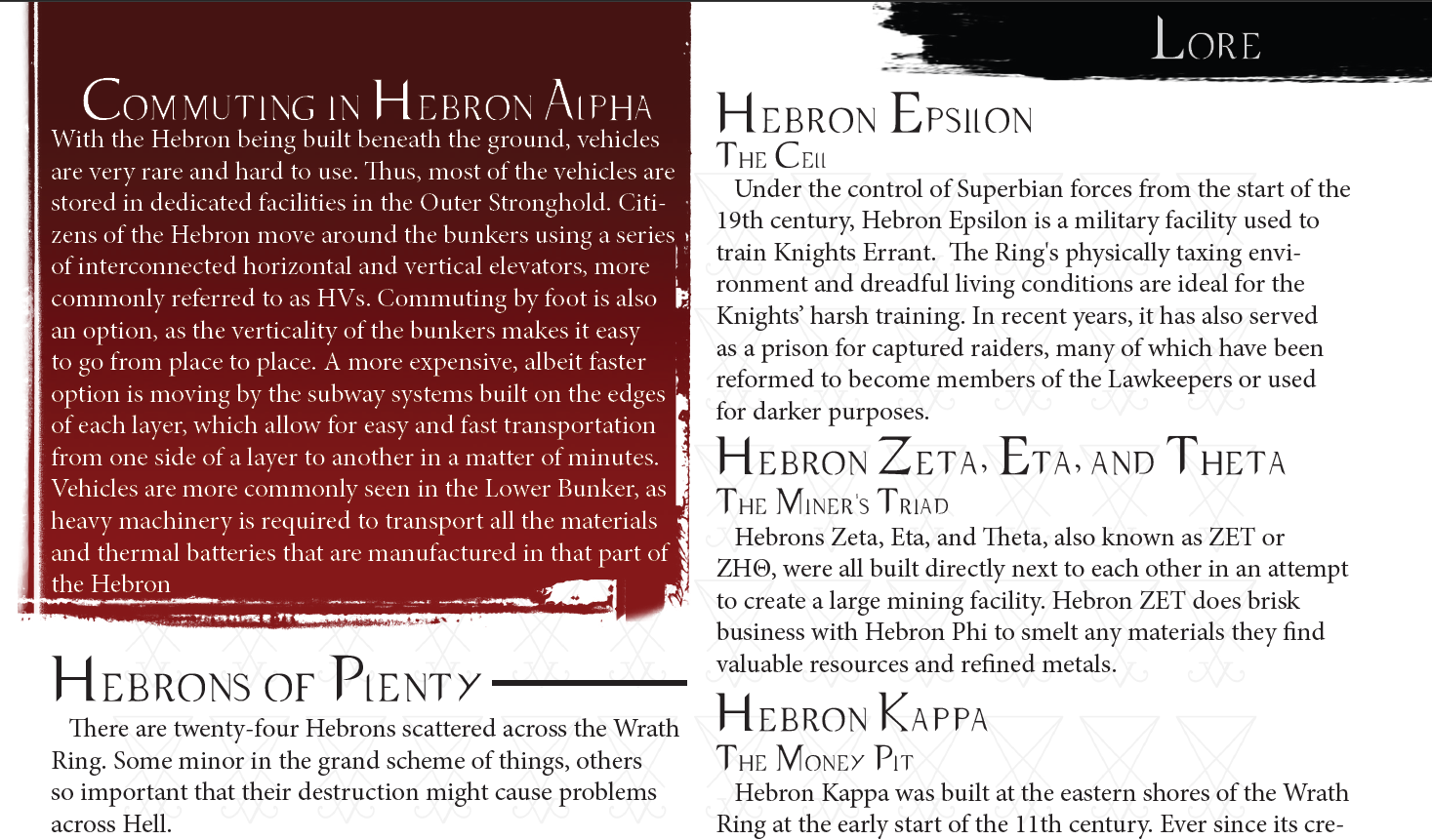
If there’s one complaint I could bring against the visual design choices, the text could be easier to read (the “L”s are difficult to differentiate from “I”s for instance), but it’s really a nit-pick more than anything. Take a glance at the phrase “Hebron Epsilon” (highlighted in mauve below). See what I mean? It’s parse-able, but if you’re scanning through the book quickly, your inner voice might trip up reading through words like this.

What Stories/Roleplay Does it Support?
If you were hoping to find a game that mimics Helluva Boss, this might be it, but sadly, Hellhounds do not appear to be playable (sorry Loona-Lovers), and the game’s lore appears to be more noir-esque and generally more serious in tone than Helluva Boss (not that it should stop you from playing what you want). Mysteries, political intrigue, heists, mercenaries (certainly), and other stories are possible. You might not show up at an Inn to get your missions, since the window dressing is hellishly different, but I suspect it to be pretty run-of-the-mill in terms of how most people will engage with it relative to other games.
Overall Opinion
The game needs some more playtesting and editing in my opinion. It’s 80% there, and it’s mostly working. That remaining extra 20% would allow more people to play with it comfortably at the table with less confusion and feeling like the game world is stacked against them. As it is, the difficulty ratings just feel too punishing without a well-rounded team, and ensuring that only a character well-trained in a skill (+2 at least) makes a necessary skill check.
If I had to play it at the table today, I’d probably do away with skills and/or reduce the difficulty ratings down a full step (making average DR as 8 rather than 10). The game feels a bit better to me if I just get rid of skills altogether and make rolls with attributes instead. Reduce the starting attribute points to make it feel a bit more like rolls in Traveller. Maybe take half of an attribute’s score for things where skills used to be mentioned in the game. (For instance, instead of the “Patch Up” ability providing 1d4 + Medicine score Hit Points, it could provide 1d4 + Half of Mind Hit Ponts.)
No telling how poorly this change would scale into late game or across every Boon Technique or Path ability that currently exists, and I’m sure there was a reason the developers added skills as well as attributes (maybe more levers to pull or more customization for characters), but I think I’d follow the idea to ground and see if it made the game feel better; more fair.
I also really wanted more interesting ideas coming out of the mechanics of the game. The fluff is great, and there’s a lot of background concerning the world (at least ninety pages worth). That’s all well-and-good, but where are the mechanics that sink their teeth into you and make you feel the push-pull between something as mythical and powerful as demonic ritual and the promising gleam of a cyberpunk future? Outside of the balancing of Essence and Cybernetics, it doesn’t seem to exist.
That’s not to say it’s a bad game; it’s an attempt to create something new, and there are good imaginations at work here. It absolutely provides the kind of customization that one wants to see in a classless system, and the choices available feel good immediately, at level 1.
It’s a game worth a look, but I personally want more than a beautiful backdrop (with high target numbers to meet or beat for “normal” checks) to play in. Anyone can put a coat of paint on a world. What’s hard is creating interesting choices for players in terms of the mechanics the system necessitates they engage with and the support of those mechanics in the world/the roleplay experience it is tied to. Hellborn needs more of both.
Where Can I Get It?
Hellborn is available now on Drivethrurpg
https://preview.drivethrurpg.com/en/product/453298/Hellborn
 Knaves and Saves